
During German occupation when food rations were inadequate, when store shelves were empty, when the occupant pillaged the country, there emerged a class of courageous men and (predominantly) women who took to the roads to smuggle food to the starving cities. They risked capital punishment by scouring the countryside for illegally raised and slaughtered animals, vegetables, and all else that sustains life. They were honored by what became the unofficial anthem of the smugglers, one of the most iconic songs of Resistance of WW2 Poland. The lyrics were written to the tune of Cielito Lindo, today one of the favorite Mariachi requests across Mexico. Smuggling during WW2 is an important topic in WITHOUT PITY...

Operation Tannenberg / Inteligenzaktion: In the years prior to the outbreak of World War Two, German Fifth Column operating inside Poland (ethnic Germans, and anyone who considred themselves of German origin, including those holding Polish nationality) was building a list of Poles slated for extermination. Death squads operated on the heels of the advancing Wehrmacht hunted down, rounded up and executed persons who could rouse the Nation to resist or hinder occupation, who could lead the masses: anyone with higher education, doctors, clergy, nobility, lawyers, officers, politicians, etc. As time went by the list grew to include anyone falling under the broad definition of intelligentsia. Hence the code name for the operation: Inteligenzaktion. Prison cells filled quickly. Mass executions by firing squads could not keep up with the intake. A new plan was hatched: a death camp was opened to facilitate a more efficient way to dispose of Poles. Its name was Auschwitz.
"All representatives of the Polish inteligentsia are to be killed," Martin Bormann, Head of Nazi Party Chancellery.

From 1939 to 1944 approximately 100,000 people were imprisoned in the dreaded place of mysery, torture and death. Of those about 37,000 were killed and / or died as a result of 'interrogations' at the hands of the Gestapo: waterboarded, pins drived under fingernails, limbs broken, burned with flame, hot iron, or simply beaten. Germans captured Poles in street roundups, raids on private homes and public spaces. They arrested and tortued men, women and children. Senior citizens in their late eighties, teenages, even toddlers were arrested -- see the case of the 6-month-old Januszek, arrested as a hostage in order for his parents to check themselves in to the Gestapo station. In an effort to cover their horrific crimes committed in Pawiak Germans destroyed the prison in 1944. Pawiak prison is prominently featured in WITHOUT PITY.
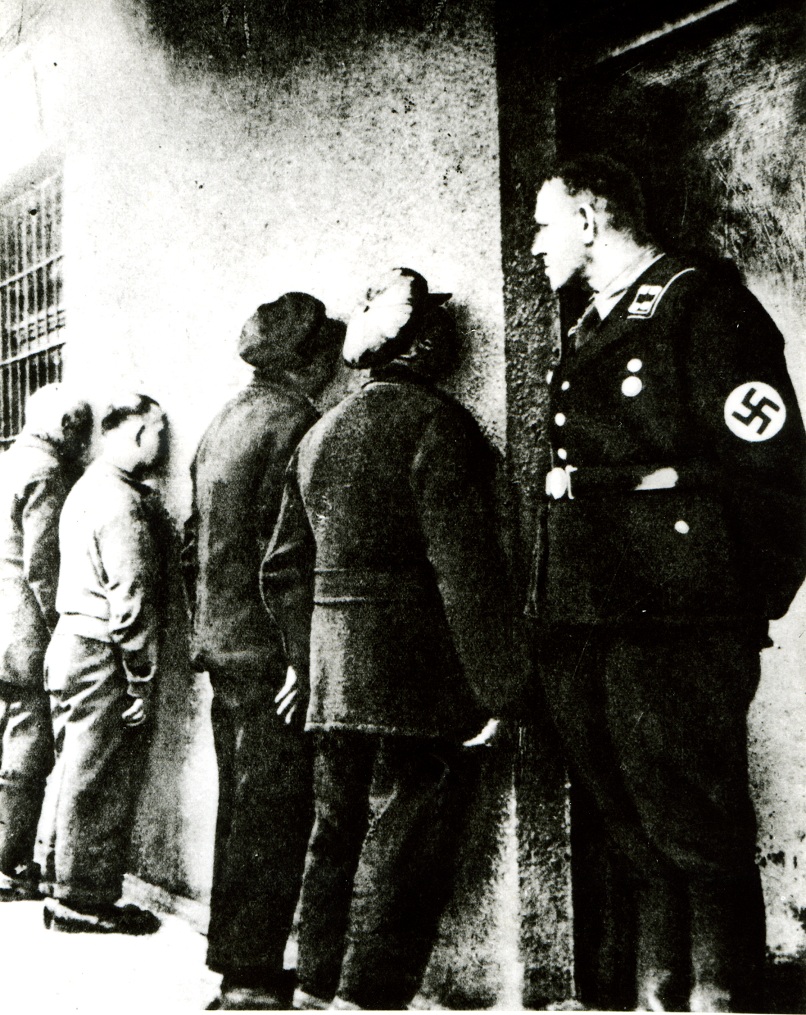
New intakes were placed against the wall. As an introduction of things to come the Gestapo monsters smashed their faces against the wall...

Prisoners were shot, hanged or "interrogated" to death...

To facilitate a more efficient mass-murder prisoners were driven to a forests outside the city where they were machine-gunned down and burried (and / or burned) in mass graves. Overtime, as the truth of the horrors of Pawiak reached the population, new prisoners would attempt to retain personal objects for future post-mortem identification...

While Pawiak Prison was the holding place of thousands of Poles, the Gestapo Headquarters located on Strasse der Polizei (Aleja Szucha) was the place where prisoners were transported to for interrogations. Transports brought the victims twice a day from Pawiak Prison, or sometimes directly from street roundups or raids. While awaiting interrogations they were crammed into dark cells, seated on benches, facing the wall. The setup resembled, and was nicknamed a "streetcar". Prisoners were forbidden to turn their heads and to communicate - disobedience was punished with severe beating.

August 1, 1944. The people rose and fought valiantly for 63 days. Hunger and horrific civilian death toll forced the command to lay down arms. But Germans suffered too and agreed to treat the insurgents as prisoners of war. In the first instance in history women combatants were also considered POWs. In retaliation for the Uprising Himmler ordered complete destruction of Warsaw. Germans looted the city first: 1,000 trains (approx. 45,000 train cars) of stolen goods left for the Reich. Special units razed what was left of the city, block-by-block, building-by-building. 84% of all buildings were destroyed: 100% industrial, 95% cultural, 90% historical (including churches), 95% health, 70% educational. For modern-day context: as of November 2025 it is estimated that some 78-83% of Gaza had been destroyed...
"I have moreover given the order to destroy Warsaw completely. The order was: to set fire to every block of houses and blow them up," Heinrich Himmler to generals, after the Warsaw Uprising.
Of the 1,000,000 residents of Warsaw an estimated 200,000 - 250,000 were killed,.
On the military side: 16,000 Polish soldiers fell, and Germans and their Ukrainians units lost approximately 1,600.
An excerpt from a testimony by an eye witness from the Wola district of Warsaw:
"I was in the last month of pregnancy, staying in the basement of the tenement house with my three children, aged 11, 6, 3.5. [...] German and Ukrainian gendarmes entered the yard, urging the population to leave immediately. When the residents emerged on the courtyard, the gendarmes threw incendiary grenades into the basements. [...]
Our group was directed toward the passage between the buildings. Corpses were already lying there. As the first four residents reached the spot where the bodies lay, the Germans and Ukrainians shot them in the neck from behind. The dead fell, and the next four approached, only to die in the same way. A limp old woman was killed on her son-in-law's back; he also died. As they were being lined up the people screamed, begged, and prayed. I was in the last four. I begged the Ukrainians surrounding us to save the children and me. One of them asked if I could buy my way out. I gave him three gold rings. After taking them, he tried to lead me away, but the German officer who was directing the execution noticed this and ordered me to join the group to be shot. I began to plead with him for the children's lives and mine, saying something about the officer's honor. However he pushed me away, causing me to fall. He also hit and pushed my older son, shouting, 'Faster, faster, you Polish bandit.'
Meanwhile, a new group of Poles was brought in. So, in the last group of four I approached the execution site with my three children, holding the two younger children's hands in my right hand and the hand of my older son in my left. The children walked crying and praying. The older one, seeing the dead shouted that they would kill us too. At one point a Ukrainian standing behind us shot my eldest son in the back of the head, and the next shots hit the younger children and me. I rolled onto my right side. The shot fired at me wasn't fatal. The bullet struck the left side of my neck and passed through the lower part of my skull, exiting through my right cheek. I suffered a pregnancy hemorrhage. I spat out several teeth along with the bullet. I felt numbness in the left side of my head and body. However, I was conscious, and lying among the corpses, I could see almost everything happening around me. I watched the executions continue. A new batch of men was brought in, and their bodies fell on me. About four corpses crushed me. Another batch of women and children was brought in – and so group after group was shot until late in the evening.
It was already dark when the executions stopped. During the breaks the executioners walked over the corpses, kicking them, knocking them down, finishing off the living, and stealing valuables. They touched the bodies through special cloths. The took a watch from my wrist, failing to notice that I was still alive. During these horrific acts they drank vodka, sang cheerful songs and laughed. Next to me lay a stout, tall man in a leather jacket, wheezing for a long time. The Germans fired five shots before he died. As they finished him off the shots wounded my leg. I lay there for a long time in a pool of blood, pressed under the corpses. I only thought about death, how much longer I would suffer. At night I pushed the dead bodies lying on top of me.
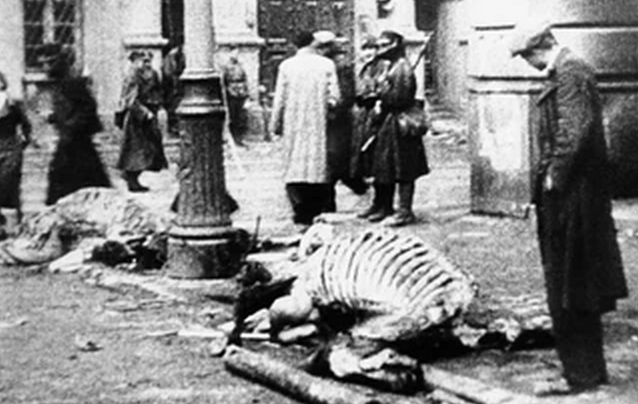
The next day, the executions stopped. The Germans only burst in a few times with dogs, running over the corpses checking the dead. I heard isolated shots; they probably finished off the living. I lay there for three days, until Monday (the execution took place on Saturday). On the third day, I felt that the child I was expecting was alive. This gave me energy and gave me the idea of rescue. I began to think and explored my options for survival. Trying to stand up several times I experienced nausea and dizziness. Finally, I crawled on all fours over the corpses to the wall. Corpses lay everywhere, as tall as I was, all over the yard. I had the impression that there might have been over 6,000 dead."
Some 63,000 were slaughtered that day in the Wola disctrict alone. Read the full text, in Polish.


February 1, 1944. A special unit of the Polish Underground executed SS Brigadier General Franz Kutschera, aka the Butcher of Warsaw. During the six months he held the position of the SS and the chief of police in General Government in Warsaw, Kutschera introduced a terror unheard of even by German wartime standards. Every few days he ordered roundups and public street exucutions, in which approximately 5,000 people were murdered. Information about the executions, along with the names of the murdered, were printed and posted all over Warsaw. The Polish Underground issued a death sentence for the crimes.
In retaliation for Kutschera's killing the Germans shot 300 Poles.
An eyewitness recalls: "Those who were killed in retaliation were carefully selected-—all were young boys. Kutschera's SS-men prepared for this spectacle with genuine joy. They occupied windows along the way of the procession as if in theater boxes. One of them brought his 15-year-old daughter so she could enjoy the spectacle. The condemned were brought in trucks from which they were thrown like sacks of potatoes, kicked and beaten. According to the established ritual of street executions, they were dressed in paper bags and had their mouths plastered so they couldn't shout 'Long live Poland!' Because their hands and feet were bound with rope, they could barely stand. They were lined up in a checkerboard formation and fired in a volley. And so it was, the first, the second, and the next rounds. Streams of blood stained the paper clothes, flowed onto the pavement, and then turned into streams flooding the sidewalk and road."
Although bloody German retaliation followed Kutschera's killing, the operation led to a halt to mass street executions.
Four days after Kutschera's execution a wedding ceremony took place. A Norwegian Jane Steen married Franz Kutschera, the executioner of Warsaw who had been dead for days. The pregnant bride, dressed in black, stood next to her fiancé's coffin, pledging love and loyalty to the corpse.
An eyewitness: "The coffin was placed on the ground floor, in the hall, amidst the stiff greenery of laurel trees. I stood among the others in the semi-darkness, observing the grim spectacle. What else could I feel at that moment but satisfaction? What inhuman times these were! The wedding plans were shattered, yet the wedding took place! The bride, showing signs of a very advanced pregnancy stood next to the catafalque. This extraordinary ceremony was held so that the unborn child could receive the surname of the father who had earned the title of the Butcher of Warsaw..."

On the heels of the quickly advancing Wehrmacht there followed Einsatzgruppen -- death squads of professional murderers who hunted down and murdered Polish civilians as part of the Operation Tanneberg / Inteligenzaktion. Too, they covered the Wehrmacht's back end -- in their bliztkrieg Drang nach Osten the German armies were terrified of partisans.
"Solving of the Polish problem ... the Einsatzgruppen must prepare the lists of Polish intelligentsia ... Round-up and arrest teachers, clergy, aristocracy, officers, engineers, physicians ... " From the meeting of high-ranking SS officers and generals, September 21, 1939.
"It is clear to anyone who knows the Polish psyche that insurgency is only a matter of time ... We must assume that a lot of weapons were buried or hidden and will be used when the time comes ... The danger of the forming of resistance groups comes from the Catholic Church, the middle class and intelligentsia." Einstatzgruppe report to the SD, September 24, 1939.
The death squads raided homes in occupied areas, arrested and executed thousands of Poles with higher and middle education, as well as those of any class who were known to exhibit anti-german sentiments before the war...

 NEXT
NEXT
Various posts related to Without Pity, its background and context. Historical events described here might not appear in chronological order

JACEKKROL.com is the best place. You can also find me on all major "social" media networks, keeping in mind my accounts had been shadowbanned (censored) or cancelled because of WITHOUT PITY.
I cannot respond to messages sent through "social" media. Say Hello...